

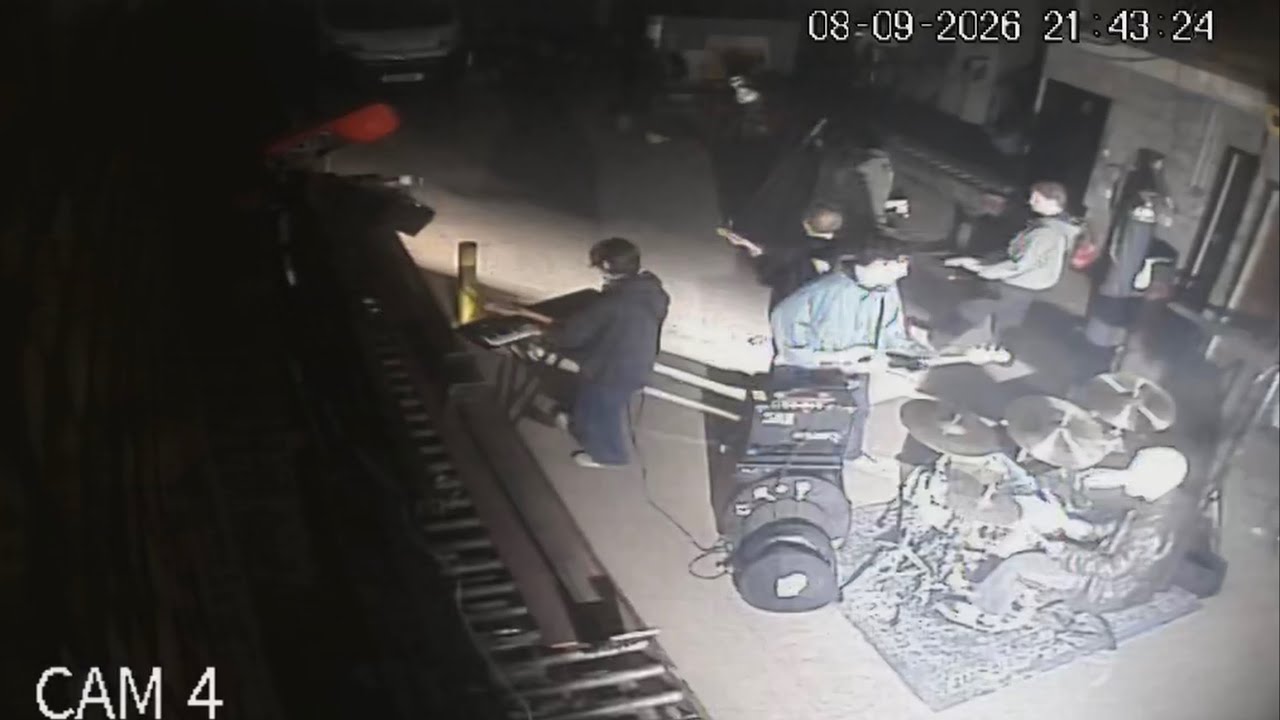


Empty Heaven (2026) by Abdolreza Kahani

Canada | 87 min | Drama / Thriller / Dark Comedy
➡️ Where to Watch: Empty Heaven is currently circulating through the international festival circuit following its World Premiere at the Edinburgh International Film Festival 2026. For film-industry professionals, programmers, distributors and accredited buyers, the film is available through Festival Scope Pro: Watch Empty Heaven on Festival Scope Pro
When the Machinery of Power Stops Working
Empty Heaven imagines political collapse not through government buildings or revolutionary spectacle, but through people suddenly discovering that the institution behind their authority has disappeared. Iranian agents operating in Canada possess valuable military-grade equipment, but when communications with Iran abruptly stop and sanctions begin to bite, their position becomes increasingly uncertain.
Abdolreza Kahani turns that institutional vacuum into a darkly comic thriller about loyalty, survival and opportunism. Instead of protecting the equipment or waiting indefinitely for instructions, the agents begin considering a more practical future: sell the components, divide the money and use the collapse of one system to finance comfortable new lives of their own.
➡️ Movie Insight: Empty Heaven asks what happens to loyalty when the institution demanding it can no longer provide protection, orders or purpose. Political collapse becomes personal temptation. The disappearance of authority reveals how quickly ideology can give way to self-preservation.
Why This Movie Matters Right Now: Political Systems Seen Through Ordinary Survival
Political cinema often approaches authoritarian power through leaders, protests or victims confronting the state. Empty Heaven takes a different route by imagining the people connected to the machinery itself suddenly stranded outside it, transforming geopolitical instability into an immediate problem of money, survival and individual choice.
That perspective also connects the film to contemporary Iranian diaspora cinema, where political realities can be explored from outside Iran while remaining intimately connected to life inside it. Kahani himself works from Canada, and the film uses that geographical distance productively: Iran's institutional crisis reaches across borders and changes the lives of people thousands of kilometres away.
➡️ Why It Matters: Empty Heaven makes geopolitics understandable through behaviour rather than explanation. Large systems matter because of what happens when ordinary people can no longer depend on them. The film turns political uncertainty into a human question: what do people do when the rules they lived by suddenly stop functioning?
Should You Watch It?: For Viewers Who Like Political Thrillers With Dark Humour
Watch Empty Heaven if you prefer political cinema that works through character, irony and moral ambiguity rather than speeches or conventional thriller spectacle. Kahani combines the mechanics of a crime story with a more unusual question about what happens to people whose identities and livelihoods were built around a political structure that may no longer exist.
The film should particularly appeal to audiences interested in Iranian cinema, diaspora stories, dry black comedy and thrillers in which the characters' decisions matter more than action sequences. Its 87-minute runtime also suggests the compactness reflected in EIFF's description of the movie as a lean, dry-humoured thriller.
➡️ Viewing Recommendation: Watch it for the unusual collision of political speculation, crime and dark comedy. The central premise is large, but the filmmaking keeps bringing its consequences back to individual behaviour. It is particularly suited to viewers who enjoy political films that leave room for ambiguity.
Why Everyone Is Talking About It?: Kahani Returns to Edinburgh After a Major Festival Win
The strongest momentum behind Empty Heaven comes from Kahani's relationship with the Edinburgh International Film Festival. His previous film, Mortician, won the Sean Connery Prize for Feature Filmmaking Excellence at EIFF in 2025, and Empty Heaven returned to the festival in 2026 for its world premiere, screening in the Out of Competition programme.
That makes the film part of a developing filmmaker-festival relationship rather than an isolated premiere. EIFF presented it as a confidently crafted character study and highlighted its inventive cinematography, performances, Canadian snowscapes and dry humour, while The Skinny included it among its films to see at the 2026 festival.
➡️ Viral Potential: Empty Heaven has a premise that can immediately generate conversation: what happens when agents of a political system discover that the system may no longer be there? Kahani's previous Edinburgh victory gives the new film additional festival credibility. Its combination of Iranian politics, criminal opportunism and dark comedy gives audiences several ways into the conversation.
Why Empty Heaven Stands Out: Turning Geopolitical Collapse Into a Character Study
The cleverness of the premise comes from changing the scale of political collapse. Instead of showing an entire country disintegrating, Kahani examines people dealing with the practical consequences of suddenly being disconnected from the structure that gave them orders, resources and authority.
The Canadian setting deepens that displacement. Snow-covered landscapes and physical distance from Iran create an environment where political loyalty becomes increasingly abstract while money, security and survival remain tangible. The thriller therefore operates simultaneously as crime story, political satire and diaspora character study.
➡️ Cinema Insight: Kahani makes political instability compelling by reducing its scale rather than enlarging it. The characters' private calculations become evidence of a much bigger institutional breakdown. Empty Heaven shows how geopolitical cinema can become more immediate when enormous political questions are filtered through small human decisions.
Movie Trend: Diaspora Political Thrillers — Geopolitics Moves Into Everyday Life
A growing space within international cinema combines diaspora storytelling with political thrillers, examining how conflicts and systems from one country continue shaping lives after characters have crossed into another. These movies move political storytelling away from capitals and institutions and toward apartments, workplaces, communities and relationships abroad.
The approach allows filmmakers to explore displacement from two directions at once. Characters may be geographically removed from their country of origin while remaining economically, emotionally or politically connected to it, creating stories where distance does not provide genuine escape.
➡️ Movie Trend: Diaspora political thrillers turn international politics into personal instability. Borders change where political conflicts are experienced without necessarily ending them. As filmmaking becomes increasingly transnational, diaspora communities can become some of cinema's most revealing spaces for examining how power travels.
Viewer Profile: For Audiences Looking Beyond the Conventional Political Thriller
Empty Heaven is positioned for viewers who want political cinema without conventional political-film storytelling. Its mixture of thriller mechanics, dry humour, diaspora experience and moral uncertainty creates several audience entry points.
Its strongest natural audience is likely to emerge through festivals and international arthouse discovery, particularly among viewers already following Iranian cinema and politically engaged filmmaking.
Audience Profile | Why It Connects |
International arthouse viewers | Character-led storytelling and moral ambiguity |
Political-thriller audiences | Institutional collapse creates the central dramatic mechanism |
Iranian cinema followers | Extends Iranian political storytelling into the diaspora |
Dark-comedy viewers | Absurdity emerges from increasingly serious circumstances |
Festival audiences | EIFF world premiere and Kahani's established festival momentum |
Industry professionals | A compact example of politically relevant transnational independent cinema |
➡️ Audience Insight: The film can reach beyond audiences specifically interested in Iranian politics because its central dilemma is universal: what happens when the system people depend upon disappears? Thriller structure makes that question accessible. Dark humour gives audiences another route into otherwise serious political material.
What This Movie Means for the Industry: Exile Filmmaking Is Becoming Its Own Creative Space
Empty Heaven demonstrates how filmmakers working outside their countries of origin can create stories that are neither conventional national cinema nor straightforward immigrant narratives. Kahani can connect Iran and Canada within the same dramatic ecosystem, using geographical separation as part of the storytelling rather than treating it simply as production circumstance.
There is also an important independent-production dimension. The Skinny notes Kahani's recent move toward self-produced filmmaking shot on an iPhone, demonstrating how increasingly lightweight production methods can give politically engaged filmmakers greater independence. That combination of technological accessibility, diaspora production and international festival circulation could become increasingly significant for filmmakers unable or unwilling to work within their countries' established production systems.
➡️ Industry Insight: Political filmmaking no longer has to originate inside the territory it examines. Diaspora filmmakers can turn geographical displacement into creative perspective while reaching audiences through international festivals. Empty Heaven suggests that small-scale production and global festival networks can provide an alternative infrastructure for politically independent cinema.
Creative Analysis: Turning Political Collapse Into a Darkly Comic Survival Story
Kahani builds Empty Heaven around a large hypothetical idea but appears determined to keep its consequences human. Rather than making institutional collapse itself the spectacle, the film follows the strange behaviours, compromises and alliances that emerge once established authority stops functioning.
Storytelling — What Happens After the Orders Stop
The central dramatic mechanism is disconnection. Once communication disappears, characters accustomed to operating within a system must begin making decisions independently, allowing the thriller to develop through uncertainty rather than a conventional mission.
Performances — People Trapped Between Loyalty and Survival
The ensemble has to make the political premise believable at an individual level. EIFF specifically praised the film's calibrated performances, suggesting that character behaviour rather than plot machinery carries much of the film's tension.
Direction — Serious Politics Through Dry Humour
Kahani avoids treating political collapse solely as tragedy. The absurdity of agents contemplating the private sale of valuable equipment creates dark comedy precisely because their behaviour exposes how fragile supposedly permanent structures can become.
Visual Style — Political Displacement in the Canadian Snow
The Canadian environment creates a striking visual separation from Iran. EIFF highlighted the film's clean, inventive cinematography and frosty Canadian landscapes, allowing physical coldness and geographical isolation to reinforce the characters' political disconnection.
Themes — Loyalty, Money and Institutional Fragility
Beneath the thriller mechanics lies a question about why people remain loyal to institutions. Once communication, authority and financial security disappear, ideology competes with immediate individual needs.
What Makes It Different — Looking at Collapse From Inside the Machinery
Rather than focusing exclusively on dissidents confronting political authority, Empty Heaven complicates the perspective by exploring people connected to the system and what happens when its power becomes uncertain. That creates morally unstable territory where political allegiances, criminal behaviour and basic self-interest begin overlapping.
➡️ Creative Insight: Empty Heaven turns institutional collapse into behavioural cinema. Kahani's strongest creative decision is to examine an enormous political hypothetical through people making increasingly practical and morally complicated choices. The resulting mixture of thriller, political satire and character study makes the film distinctive.
The Seed of the Sacred Fig (2024) by Mohammad Rasoulof
Mohammad Rasoulof's political drama follows an investigating judge in Tehran whose position within Iran's political system begins destabilising his own family as nationwide protests intensify. Political authority enters the domestic space, transforming ideological conflict into distrust between people who should know one another best.
➡️ Why It Connects: Like Empty Heaven, the film looks at political systems through people caught inside their machinery. Institutional loyalty gradually becomes inseparable from personal survival. Both films reveal how quickly private relationships can change when the authority surrounding them becomes unstable.
No Bears (2022) by Jafar Panahi
Jafar Panahi blurs fiction and reality through the story of a filmmaker working close to the Iranian border while remotely directing another story involving a couple attempting to leave the country. Borders, surveillance, tradition and individual freedom gradually overlap until geographical distance provides little protection from the systems surrounding the characters.
➡️ Why It Connects: Both films explore what happens when political power continues shaping behaviour even at a distance. Geography does not necessarily mean freedom from the system left behind. That makes No Bears especially relevant to the transnational political perspective running through Empty Heaven.
Tatami (2024) by Guy Nattiv and Zar Amir Ebrahimi
Set during an international judo championship, Tatami follows an Iranian athlete ordered to withdraw because she could potentially face an Israeli opponent. What begins as sporting competition becomes a political thriller about whether obedience to the state remains compatible with personal ambition and individual freedom.
➡️ Why It Connects: Tatami similarly makes geopolitics immediate by placing institutional pressure onto an individual decision. The conflict becomes a struggle between personal agency and the demands of a political system. Like Empty Heaven, it asks what remains of loyalty once following orders begins threatening an individual's future.
I would not include UK or Canada for Tatami because current JustWatch listings specifically show it as unavailable there.
➡️ If You Liked Insight: These films represent a strand of contemporary political cinema in which geopolitical conflict becomes most powerful when experienced through individual behaviour. Instead of explaining political systems from the outside, they place characters inside situations where loyalty, survival and personal freedom collide. Empty Heaven extends that approach into diaspora thriller territory by asking what happens when the system itself suddenly stops answering.
Final Verdict: A Political Thriller About What People Do When Power Disappears
Empty Heaven takes an ambitious geopolitical premise and finds its drama in something much smaller: human adaptability. Kahani is less interested in depicting the spectacle of a collapsing system than in observing how rapidly people's relationship with that system changes once it stops providing certainty.
That makes the film potentially more provocative than a straightforward political thriller. The agents' predicament becomes a dark experiment in loyalty, greed, fear and survival, while Canada provides the distant landscape in which the consequences of another country's political instability unexpectedly arrive.
➡️ Final Verdict: Empty Heaven is a compact political thriller with an unusually sharp conceptual hook. Its combination of institutional collapse, diaspora experience, crime and dry humour gives familiar geopolitical material a different perspective. Kahani turns the disappearance of authority into a revealing study of what people choose when nobody is left to tell them what to do.
Quick Facts: Empty Heaven at a Glance
Title | Empty Heaven |
Year | 2026 |
Director | Abdolreza Kahani |
Writer | Abdolreza Kahani |
Country | Canada |
Language | Persian / Farsi |
Runtime | 87 minutes |
Genre | Drama / Thriller / Dark Comedy |
Setting | Canada |
Festival Premiere | Edinburgh International Film Festival 2026 |
Premiere Status | World Premiere |
Festival Section | Out of Competition |
Key Cast | Aida Rezaei, Diana Laalkaei, Fatima Rouzi, Hamidreza Hosseini, Hanieh Borghei, Mahdi Eftekhari, Nima Sadr, Pouya Razavi, Zahra Masoumi |
Cinematography | Abdolreza Kahani |
Editing | Abdolreza Kahani |
Music | Alireza Hezaryan |
Industry Viewing | Festival Scope Pro |
Final Insights: Political Cinema Is Becoming More Transnational
The broader significance of Empty Heaven lies in how naturally it moves political cinema beyond national borders. Contemporary political systems affect people, communities and institutions far beyond the territories they govern, and diaspora filmmaking gives cinema an increasingly powerful way of representing those connections. A political thriller set in Canada can therefore remain fundamentally connected to Iran without needing to physically return there.
This could become an increasingly important direction for international independent cinema. Filmmakers working across borders can combine personal knowledge of one political culture with the creative freedom and production infrastructure of another, while festivals provide the networks through which those films reach international audiences. The result is political cinema that is simultaneously local, displaced and global.
➡️ Final Insight: The next generation of political cinema may increasingly emerge between countries rather than entirely within them. Diaspora filmmakers can use distance to reveal how political power continues affecting people long after they cross a border. Empty Heaven turns that transnational condition into the foundation of its thriller.


Comments